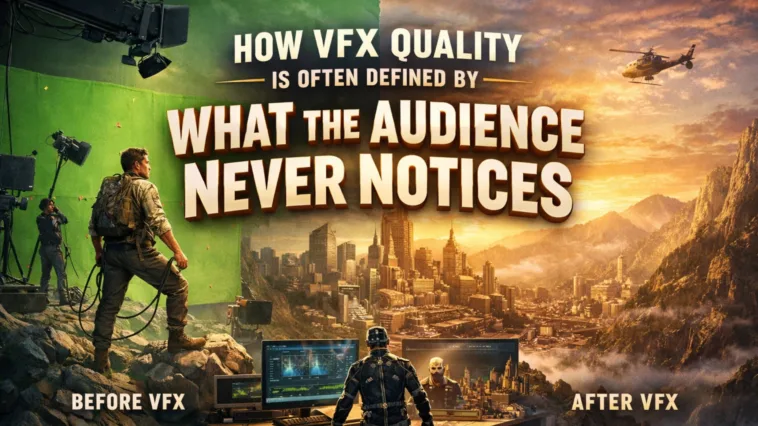
When most people think of great visual effects, they envision sprawling fantasy worlds, explosive action sequences, or digital creatures that dominate the screen. And yes, those are visual effects.
But speak to any experienced VFX artist, and you’ll hear something different:
The best visual effects in film and television are often the kind you never notice.
In fact, if audiences leave a theatre talking about the performances, the story, or how real everything felt, rather than the effects, that’s usually a sign the VFX team did their job well. Their work strengthened the narrative without pulling attention away from it.
Check Our VFX Service
Great VFX is about story over spectacle
Spectacle has its place. Films like Avengers: Endgame or Avatar rely heavily on visual effects to build worlds that would otherwise be impossible to capture on camera.
But even in these large-scale productions, the reason the VFX works isn’t simply because it looks impressive. It works because it serves the narrative.
When effects are integrated properly, the audience isn’t thinking, “That’s great CGI.”
They are thinking, “I believe this world.”
When effects call unnecessary attention to themselves, they disrupt that immersion. And once a viewer steps outside the story to analyze the technique, emotional engagement weakens.
What counts as Invisible VFX
Invisible VFX refers to visual effects designed specifically not to be noticed. These effects smooth over production limitations, preserve continuity, and enhance realism without changing the tone of a scene.
Here are some of the most common forms of invisible VFX used across film, television, commercials, and branded content:
1. Wire and rig removal
Actors are often secured to harnesses, wires, and mechanical rigs to perform complex stunts safely. While essential on set, this equipment is often visible in the raw footage and must disappear in the final shot.
VFX artists remove these elements frame by frame, rebuilding obscured backgrounds, matching lighting and shadows, and preserving natural motion blur so the action feels completely seamless.
For example, in The Wolf of Wall Street, several high-energy party and stunt moments required subtle digital cleanup. Artists erased safety gear and environmental distractions so the scenes retained their chaotic, spontaneous energy.
2. Set extensions and environment enhancement
Rather than constructing massive sets or traveling to dozens of locations, productions often film what’s practical and then hire VFX artist to expand, modify, or enhance the world digitally in post-production.
Set extensions allow filmmakers to:
- Extend physical sets beyond their real boundaries
- Add large-scale architecture or landscapes that weren’t built
- Enhance atmosphere with weather, lighting, or environmental details
- Remove unwanted elements (modern buildings, signage)
Consider The Irishman. While widely recognized for its de-aging work, much of its visual effects effort also went into subtle set extensions and background modifications that maintained historical accuracy. Most viewers never registered these changes, yet they shaped the film’s authenticity.
3. Crowd duplication
Crowd duplication (also called crowd replication or multiplication) is a VFX technique used to make a small group of people appear like a large crowd.
Instead of hiring thousands of people, which requires enormous budgets, permits, and coordination, filmmakers often partner with a VFX company or hire VFX artists to expand the crowd digitally in post-production.
This technique is commonly used in:
- Stadium scenes
- War sequences
- Political rallies
- Concerts and large-scale celebrations
For example, in Gladiator, the Colosseum scenes appear packed with tens of thousands of spectators. In reality, only a fraction of that number was filmed on set, and the rest of the crowd was digitally replicated and extended.
Similarly, the massive battle sequences in The Lord of the Rings: The Return of the King used advanced digital crowd systems to create massive armies without overwhelming production logistics.
Invisible VFX requires focus that most in-house teams don’t have
Removing rigs, fixing continuity gaps, extending sets, or cleaning up backgrounds requires detailed, frame-by-frame attention and a strong understanding of lighting, perspective, and movement. Even small inconsistencies can break realism.
For filmmakers, production teams, content creators, and brands, that level of focus doesn’t always align with production realities. Managing shoots, revisions, deadlines, and multiple projects leaves little room for the kind of meticulous refinement invisible VFX demands. And because this work can’t be rushed or automated without compromising quality, many teams choose to hire VFX artists or partner with a specialized VFX studio.
At Motion Edits, our team provides professional VFX services that integrate seamlessly into your post-production workflow. We handle cleanup, object removal, continuity corrections, and background fixes with technical precision, so you can stay focused on the bigger creative picture while we ensure your final cut feels cohesive and immersive.
If your team is stretched thin and you’re looking to outsource VFX, contact us to see how our team can support your next project.
Check Our VFX Service