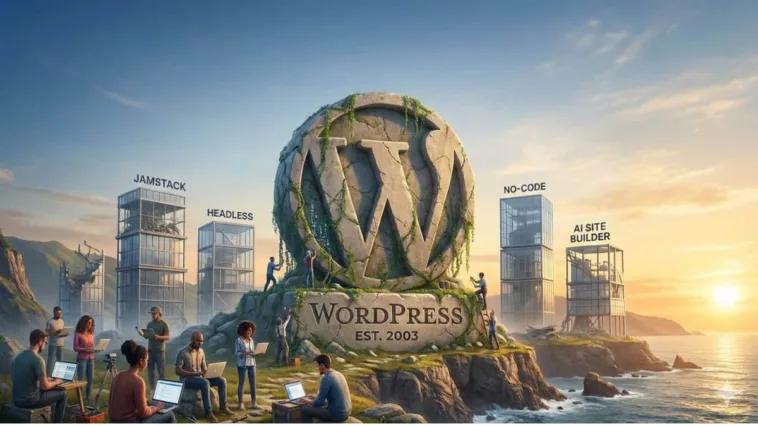
It is 2026. We have self-driving cars that mostly work. We have AI that can write entire software applications. Yet if you look at the actual infrastructure of the web, nearly 43% of it is still powered by a platform that launched when the first iPhone was still just a twinkle in Steve Jobs’s eye.
Sit with that for a second.
In a tech landscape that moves this fast, software that’s over two decades old should be a museum piece. Instead, we are all still driving around in something like a 2003 Honda Civic. Reliable, sure. Not exactly thrilling, but somehow it keeps getting the job done.
We’re talking about WordPress, of course.
The question I’ve been wrestling with is the one people keep asking every year: is there actually a replacement yet?
Every time someone declares “WordPress is dead,” it seems to grow another few percent. It’s the cockroach of the internet, and I mean that as a compliment to its survival skills.
I didn’t come to this question through abstract industry analysis. I came to it through my own house.
The Question Came From An Unexpected Place
After spending over two decades in the WordPress ecosystem, building sites and plugins, running WP Mayor, and watching the platform evolve, I recently found myself asking something I never expected to ask.
Is it time to look elsewhere?
The catalyst was my seven-year-old son. He wants to build his first website. He has ideas. A blog about football. RC cars. Retro gaming. Places he’s travelled. The kind of personal site that used to be everywhere before social media swallowed the web.
I hesitated.
Do I teach him WordPress, the same way I learned it twenty years ago? Or has something better finally arrived, something more modern, more suitable for a beginner in 2026?
It sounds like a simple question. The problem is it has surprisingly few good answers. Once you start digging, you realise every WordPress developer or agency owner should probably go down the same rabbit hole at least once.
The Dark Cloud Over 2025
There was another reason this question suddenly felt urgent.
WordPress drama isn’t new, but the governance drama in 2024 and 2025 between Automattic and WP Engine landed differently than the usual ecosystem noise.
If you missed it: Matt Mullenweg, who controls both Automattic and the WordPress.org infrastructure, got into a public dispute with WP Engine over trademark usage and what he saw as insufficient contribution back to WordPress. It escalated to Automattic blocking WP Engine’s access to WordPress.org plugin updates, effectively weaponizing shared infrastructure against a major host. Legal action followed.
Whatever you think about either side, it revealed something uncomfortable.
The WordPress ecosystem has a single point of failure. One person’s decision disrupted the plugin update mechanism that millions of sites depend on. That kind of governance risk didn’t feel real until it happened.
It felt a bit like discovering your electricity provider can turn off your lights because they’re mad at the guy who built your house.
It made me think. If the future of WordPress can be shaped by the mood of one person, it’s worth knowing what else is out there.
So I went looking. Properly. Not a quick Google or ChatGPT search. A real evaluation of what could realistically replace WordPress for the kind of work most of us do.
I should be upfront before going on: I founded and ran WP Mayor for years. I’ve built my career in this ecosystem for over two decades. I’m not a neutral observer. That’s exactly why I take the question seriously. If I’m going to teach my son something, I want it to be the right thing. I’d rather face an uncomfortable answer honestly than keep my head in the sand.
Here’s what I found.
Nothing.
And that’s actually the story worth telling.

The Landscape Today
WordPress powers around 43% of the web. When you have dominance at that scale, “replacement” isn’t really the right framing. It’s closer to asking what could replace email or the web browser.
Still, let’s take the alternatives seriously.
Static Site Generators (Astro, Hugo, Eleventy)
These are the darlings of the developer community. Astro in particular has real momentum. You write content in Markdown or HTML, generate static files, and deploy to Netlify or Vercel, often for free.
The output is blazing fast. No database. No PHP. No security patches. Just HTML files.
On paper it sounds like the obvious move. Faster, more secure, cheaper to host.
So why aren’t we all using it?
Because of what I think of as the client problem.
Let’s say you run a bakery and you want to update your “daily specials” page.
On WordPress, you log in, type “blueberry muffins,” hit Update, and you’re done.
With a static site generator, there is no dashboard. No login. You edit files in a code editor. You push to Git. You trigger a rebuild. You deploy.
You’re trying to sell muffins, not hack the Pentagon.
For developers building their own sites, this workflow can be genuinely pleasant. For clients who need to manage their own content, it’s a dead end. You’d spend more time training them than building the site.
Static generators aren’t WordPress replacements. They’re developer tools that happen to produce websites.
Modern PHP CMSs (Statamic, Craft, October)
This is where it gets interesting, and then disappointing.
Statamic is built on Laravel and it’s genuinely lovely to work with. Clean codebase, beautiful control panel, flat-file storage options so you can version-control everything in Git.
It feels like “what if we rebuilt WordPress today with modern architecture.”
This is the part where people expect the story to turn. Dashboard for the muffin man, clean code for the developer. Surely this is the winner.
It isn’t. Not commercially, at least.
Because if you’re going to use something that fills the same role as WordPress, you eventually run into the same wall: ecosystem.
Statamic trades WordPress’s gravity for elegance. It’s like buying a beautifully engineered boutique sports car when WordPress is a 2005 Toyota Camry.
The sports car is more fun. It’s better designed.
Then it breaks down at 2am on a road trip.
With the Toyota, any mechanic in any town can fix it. Parts are everywhere. With the boutique car, the specialist might be three states away and charges $500 an hour.
In business, serviceability often beats engineering purity. You want to know that if your developer gets hit by a bus, you can hire one of the other millions of WordPress developers tomorrow.
Craft CMS is similar. Great developer experience, excellent content modelling, but a tiny ecosystem. October CMS tried to be the Laravel-WordPress hybrid and never got real traction.
ClassicPress is worth mentioning too, a fork of WordPress that stripped out Gutenberg and aims to maintain a more traditional, stable WordPress experience. If your main complaint is the block editor direction, ClassicPress addresses that directly. But it inherits the same limitation as the other alternatives: a much smaller ecosystem. Plugins built specifically for Gutenberg won’t work. The developer community is a fraction of WordPress’s. It’s viable in specific situations, but it’s not a path to growth.
None of these are going to grow beyond niche. The network effects aren’t there and probably never will be.
Headless CMS Options (Strapi, Directus, Sanity, Contentful)
Headless CMS separates your content management from your frontend. You store content in a CMS with an API, then build your frontend however you want, React, Vue, static HTML, whatever.
Headless is powerful if you’re sending content to multiple surfaces. A website, a mobile app, maybe the “smart fridge” version of your product catalogue.
For a typical website or blog, it’s overengineered. You now need to build and maintain two things instead of one. Many options either have usage-based pricing (Contentful, Sanity) or require significant technical overhead to self-host (Strapi, Directus).
Not a WordPress replacement. A different tool for different problems.
Hosted Website Builders (Squarespace, Wix, Webflow)
These took the “I just want a simple website” crowd from WordPress, and honestly, good for them. Someone who would have struggled with WordPress anyway is often better served by Squarespace.
But these are subscription services with limited flexibility. You’re renting, not owning. The moment you want to do something the platform doesn’t support, you hit a wall. Then you keep paying monthly forever, or you start over.
Different market, not a replacement.
The One Exception: Shopify
There is one place where WordPress genuinely lost territory: e-commerce, specifically WooCommerce.
Shopify succeeded by being opinionated and hosted. You don’t think about servers, updates, security, or plugins conflicting. You just sell stuff. That convenience premium turned out to be worth a lot to merchants who’d rather focus on their products than their stack.
If you’re building e-commerce today and you’re not a developer, Shopify is often the right answer. That wasn’t true ten years ago.

So Why Does WordPress Still Win?
WordPress’s moat isn’t the technology. The technology is arguably its weakest point: legacy code, awkward plugin architecture, and a Gutenberg direction that’s divided the community.
The moat is the ecosystem, and at the center of that ecosystem is the plugin directory.
There are over 60,000 plugins in the official repository, plus thousands more sold commercially. Need SEO tools? Multiple mature options. Need e-commerce? WooCommerce and its hundreds of extensions. Need to display your Instagram feed beautifully? Spotlight handles that. Need to aggregate content from RSS feeds across the web? WP RSS Aggregator has been doing that for over a decade.
Need membership functionality, booking systems, form builders, multilingual support, backup solutions, security hardening, performance optimization, affiliate management, email marketing integration? Someone built it. Probably several someones.
This is the part newer platforms cannot shortcut.
You can build a technically superior CMS in a year or two. You cannot build an ecosystem of tens of thousands of plugins developed over two decades. Every time someone evaluates a WordPress alternative, they eventually hit a feature they need that either doesn’t exist on the new platform or requires custom development. That’s the moment they come back.
Then there’s what I call the 2am education problem.
If you’re stuck at 2:00 in the morning because your site is broken, WordPress has a safety net. You Google the issue and you find a step-by-step tutorial, a couple of YouTube videos, and a forum thread from 2018 solving that exact problem.
Try that with Statamic. You might find documentation written for developers, or a Discord channel where you hope someone answers tomorrow.
WordPress has millions of developers who know it, hosting companies offering one-click installs, twenty years of Stack Overflow answers, and a mental model that non-technical people actually understand. Then there’s the educational ecosystem, hundreds of blogs, YouTube channels, and communities dedicated to teaching WordPress for free. Sites like WP Mayor, WPBeginner, and countless others have spent years creating tutorials, reviews, and guides.
The plugin ecosystem is the killer feature. It’s the convenience premium. It’s what lets a non-developer build a genuinely complex site without writing code.
To displace WordPress, you’d need to replicate all of that. Not just a better CMS, but the entire ecosystem around it. That takes a decade and a lot of luck.
What About AI?
There’s one wildcard worth considering: could AI change this equation?
The plugin ecosystem advantage exists partly because custom development is expensive and slow. If you need functionality that doesn’t exist as a plugin, you either pay a developer or learn to code yourself.
AI is making custom development faster and cheaper.
Tools like Claude and Cursor let developers build features in hours that used to take days. Non-developers are starting to build simple tools themselves with AI assistance. If this trend holds, the “just install a plugin” advantage might erode.
That doesn’t necessarily mean WordPress loses. It could go two ways.
One future is that AI levels the playing field. Cleaner platforms become viable because AI bridges the missing-feature gap. You don’t need a massive repository if you can generate what you need on demand.
The other future is that WordPress gets stronger because its open, extensible architecture becomes even more valuable when AI can generate custom plugins quickly, and because established plugins integrate AI into existing products. The lines are already blurring. Products like WP RSS Aggregator are heavily implementing AI features into their stack.
So the question isn’t just “WordPress or something else.” It’s increasingly “WordPress with AI, custom AI-powered apps, or some hybrid we haven’t fully defined yet.”
I don’t know exactly how it plays out. Through AgentVania, I’m actively helping small businesses implement AI solutions, custom integrations that could become standalone apps, WordPress plugins with AI at their core, or something else entirely. The opportunity feels real, even if the final shape isn’t clear.
If you’re making technology bets for the next decade, it’s worth considering the calculus may shift in ways we can’t fully predict. Staying close to both WordPress and AI feels like a reasonable hedge.
So What Should You Actually Use?
It depends on what you’re building. Before we get into specifics, one point is worth stating plainly.
The plugin ecosystem is why WordPress remains dominant. Not the core. The core is showing its age. The reason WordPress stays the default is that whatever you need, someone has probably already built it.
When you choose a newer CMS with a limited plugin or app collection, you’re betting you won’t need extended functionality, or you’re prepared to build it yourself. Sometimes that’s right. Often it isn’t.
With that in mind:
For a SaaS marketing site, WordPress works but is often overkill. Astro or another static generator is ideal when developers manage it in Git. If non-technical marketing needs frequent edits, WordPress or Webflow make more sense.
For the SaaS application itself, never WordPress. Build with Laravel, Next.js, Rails, or whatever fits your team.
For a blog, WordPress remains the sensible default. The SEO plugin ecosystem alone is hard to replicate. If you’re technical and want minimal, Astro works well. Ghost is worth considering for memberships and newsletters, but you’re back to subscription pricing for hosting.
For a brochure site, WordPress if the client needs to edit. If it’s truly static, a static generator on Netlify is simpler and cheap. Squarespace is fine if you don’t want maintenance responsibility.
For an aggregator site, WordPress shines. Custom post types, Advanced Custom Fields, and plugins like WP RSS Aggregator let you model complex content and pull in external feeds without building from scratch. If you need heavy custom beyond plugins, Laravel becomes a better foundation, but you’re committing to building and maintaining everything yourself.
For a dashboard or internal admin panel, never WordPress. Use Laravel with Filament or Livewire, or a modern frontend with an API. Retool or Budibase if you want low-code.
For e-commerce, Shopify unless you have a specific reason to avoid it. WooCommerce remains viable if you need full control and can handle the maintenance burden.
For a membership or course site, WordPress with LearnDash, MemberPress, or Restrict Content Pro remains the established route. Hosted alternatives work but lock you in. WordPress wins when you want ownership and integrations.
For a forum/community, WordPress with BuddyPress or bbPress works but can feel clunky. Discourse is better but separate. Circle is subscription-based. In many cases, Slack/Discord/Telegram have replaced traditional forums.
For a portfolio, WordPress or Squarespace both work. Squarespace templates are often stronger out of the box for visual work. If you’re technical, a static site is cleaner and faster. For Instagram-heavy portfolios, Spotlight makes that easy.
For a news/media site, WordPress dominates. Editorial workflows, roles, scheduling, and the plugin ecosystem for ads, analytics, paywalls, and newsletters are hard to match.
For multilingual, WordPress with WPML or Polylang. Multilingual is complicated, and those plugins have solved edge cases you do not want to rediscover.
For a single campaign landing page, you often don’t need a CMS. A static page, Webflow, or Carrd is often the right answer.
The pattern is consistent. WordPress wins when you need a content-managed site that non-technical people will edit, especially when you need functionality beyond basic pages. Custom code wins for applications. Static wins when developers manage everything and performance matters. Shopify wins for selling products online to consumers.
So What About My Son?
Back to the original question.
What do I teach a seven-year-old who wants to publish his ideas online?
The purist in me considered static site generators. Teach HTML, CSS, JavaScript from day one. No abstractions. Just fundamentals.
It’s not realistic.
He wants to write about football and share photos from our travels. The gap between “I have an idea” and “it’s live on the internet” needs to be tiny. Otherwise the excitement dies before the first post goes up.
Hosted builders are tempting because they’re easy, but they’re subscription services that teach you nothing transferable. If he outgrows them, he starts over. I’d rather he owned his content from day one.
So I’m going with WordPress. Not because it’s perfect, but because it hits the right balance:
He can publish immediately. That immediate feedback matters when you’re seven, and honestly, it matters for adults too.
There’s depth when he’s ready. Start with writing, then themes, then plugins, then code.
The skills transfer. Content management, hosting, domains, databases, mental models that apply everywhere.
I know it. If he gets stuck, I can actually help him. Teaching what you know has value beyond the tool itself.
Twenty years later, I’m teaching the same platform I learned on. That says something, either about WordPress’s staying power, the lack of alternatives, or both.
What This Means
If you’re a developer or agency wondering whether to jump ship, the honest answer is: there’s nowhere to jump to. Not yet.
If WordPress governance makes you uneasy, I think that’s reasonable. The practical response is to keep your skills portable. Learn modern PHP and JavaScript. Understand principles, not just WordPress-specific patterns. If something does emerge, you’ll be ready.
If you’re building a new site today and you need a CMS with an admin panel that non-technical people can use, WordPress is still the answer. I wish I had something more exciting to tell you.
The gap in the market is real. A modern, open-source CMS with Statamic-grade architecture and WordPress-level usability and ecosystem would be genuinely valuable. Nobody has built it yet.
Maybe it’s impossible.
Maybe it’s the next billion-dollar opportunity.
I’ve spent over a decade in the WordPress world and I’m genuinely wrestling with these questions. What do you think? Have I missed something? Is there a platform gaining traction that deserves more attention? Let me know in the comments or reach out on X/Twitter.